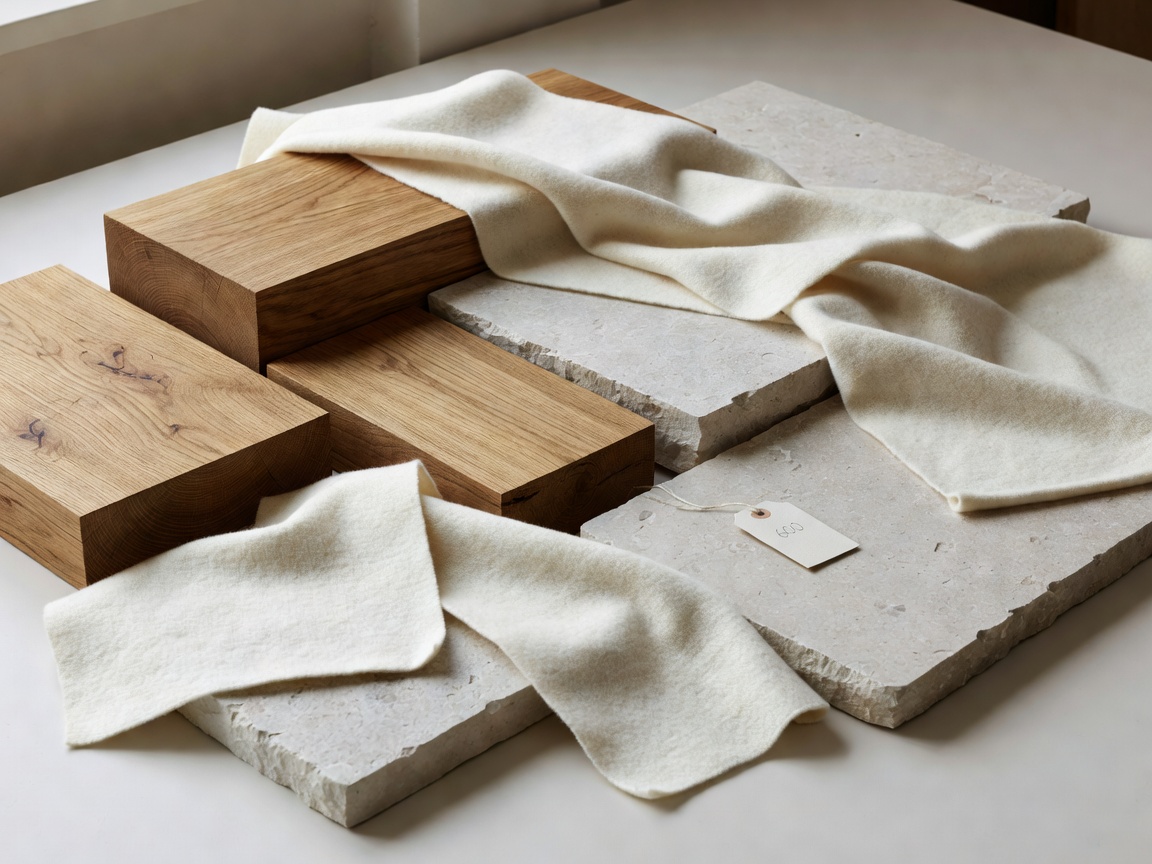
The Principle of Material Integrity
In synthetic modern building practices, finishes are engineered to look perpetually brand-new until they abruptly fail and end up in a landfill. Clipscoutbrowsebarn rejects composite laminates, plasticized protective varnishes, and artificial stone substitutes. We believe an authentic interior must possess the capacity to age gracefully. Scratches on a solid soap-finished oak bench or etching across a limestone vanity are not defects; they are the physical markers of human habitancy.
Our material specifications prioritize low-processed, regional elements sourced within the Baltic and Scandinavian basin. By utilizing materials in their raw or minimally treated states, we safeguard indoor air chemistry while providing sensory grounding for occupants who spend their working hours touching glass screens.
Our Core Architectural Material Palette
1. Slow-Grown Danish & German White Oak (Quercus robur)
Harvested from sustainably managed forests where tight annular growth rings ensure dense cell structure. We finish our oak joinery and broad plank flooring using traditional white lye and natural vegetable soap. This breathable technique prevents the yellowing associated with polyurethane while keeping the wood grain open to regulate ambient humidity.
2. Gotland Limestone (Öland & Slite Deposits)
Quarried from Sweden’s ancient fossilized seabeds, this dense grey limestone exhibits subtle fossil inclusions and soft cloud-like tonal variations. Honed to a matte 200-grit finish without artificial surface resins, it serves as counter surface, hearth cladding, and shower slab.
3. Lime & Clay Plasters
Rather than applying synthetic acrylic emulsion paints, our studio applies multi-coat hydrated slaked lime and Danish clay plasters. These mineral binders form micro-crystalline bonds directly with masonry partitions. They are completely free from volatile organic compounds (VOCs) and naturally alkaline, resisting mold growth without biocides.
4. Unlacquered Architectural Bronze & Brass
Every door handle, electrical faceplate, and plumbing fitting is forged from solid, unlacquered copper alloys. In high-touch zones, the metal burnishes to a brilliant golden sheen, while recessed surfaces deepen into rich chocolate patinas through atmospheric oxidation.
"A synthetic surface depreciates from day one. A natural surface starts its life on day one, gathering character with every touch."
— Mette Friis, Head of Materials at ClipscoutbrowsebarnMaterial Selection Matrix & Life Cycle Properties
| Material | Origin | Surface Treatment | Expected Lifespan | End-of-Life Status |
|---|---|---|---|---|
| Solid White Oak Planks | Jutland, Denmark | Nordic white lye & vegetable soap | 100+ years (can be re-planed 6x) | 100% Biodegradable / Circular |
| Gotland Limestone | Gotland, Sweden | Matte honed, impregnating stone oil | Indefinite (centuries) | Crushed aggregate reuse |
| Danish Clay Plaster | Bornholm, Denmark | Unsealed raw burnished clay | 40+ years (re-hydratable) | Zero-impact compostable |
| Unbleached Belgian Linen | Flanders / Nordic weave | Enzyme pre-washed, unbleached | 15–25 years | 100% Compostable natural fiber |
Tactile Cohesion: Curating the Sensory Experience
When developing a residential palette, our architects employ what we term "sensory zoning." Cold, hard, and reflective materials (such as stone slabs and cold-rolled steel) are anchored to wet facilities and kitchen work areas. As a resident transitions toward relaxation zones and sleeping suites, the palette systematically softens: transitioning through brushed oak, hand-troweled clay walls, wool bouclé upholstery, and heavy sheer linen curtains.
This gradual transition calms the neurological system. In our fast-paced society, returning home to a dwelling composed of natural elements re-establishes a primal tactile bond that no synthetic laminate or printed vinyl plank can emulate.